KISS Explorers & Professionals
Jason Richards - Explorer, Cartographer
 Jason Richards makes cave maps and conducts exploration all over the Western Hemisphere. His most popular maps include the 40 mile long Blue Spring Cave in White county, Tennessee; Hole in the Wall Cave in Marianna, Florida; Wet Dream Cave, Vancouver Island, Canada, and The Cenote Crustacea cave system in Quintana Roo, Mexico. In addition, he has led exploration all over North America, to include the deepest cave in Canada (Hole in the Wall, BC), he found an additional mile of cave in Tongue River Cave, Wyoming; The two longest underwater caves in the United States outside of Florida: Jasper Blue Spring, TN, and Cow Crap Cave, TN, and 27 kilometers of new cave in an unnamed cave system in Quintana Roo, Mexico.
 In addition, he just recently connected a nearby cave to Russell Cave National Monument via an underwater connection 25 years in the making. He is continuously adapting equipment to create the most efficient system for diving very small cave entrances, and passages that require a long trip through cave to get to the water. The KISS sidewinder allows him to access more caves with smaller entrances and packs efficiently for carrying through caves to get to the water and continue exploration.
Jason Mallinson - Explorer, Rescuer
 Jason Mallinson learnt his tradecraft in the cold murky sumps of North Yorkshire, England in the early 90’s, where side-mount solo cave diving was the norm. From these sound foundations he quickly progressed to mixed gas diving, and before the time that rebreathers were in mainstream cave diving, long range multi-stage OC dives were carried out mainly in mainland Europe. Notable OC explorations were made at the Emergence de Ressel in France, and soon after the transition to CC rebreathers was made.
This allowed Jason to make further explorations, always pushing the envelope of what at the time was thought possible. The Classic KISS became the rebreather of choice and with the Pozo Azul (Spain) explorations beginning in 2001, this culminated in a world record, total penetration dive distance of 8825m in 2010 (now 9km+).
Jason specializes in diving sumps at the bottom of deep dry cave systems and has extensive caving experience. Sistema Cheve (1484m) and Sistema Huautla (1540m) in Mexico, both held the Western Hemisphere depth record. SIMA GESM (1240m) and BU56 (1408m) in Spain were also dived using KISS rebreathers. Jason is also a rescue call-out diver and has carried out rescue and recovery operations in UK, Mexico, France, Norway and Ireland where local authorities have requested specialist assistance.
Curt Bowen - Explorer, Photographer, Publisher Advanced Diver Magazine
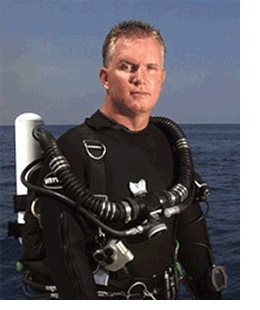 Curt Bowen started his diving career at a young age when he moved from his land-locked home state of Iowa to the beaches of Sarasota, Florida. As with the case of many divers, he was drawn to the underwater environment by watching the Cousteau specials as a child.
Following years of diving and continued education to higher certifications, Curt become heavily involved in deep cave and wreck exploration in the late 80’s. For many years Curt performed in the role of technical instructor, teaching extended range, decompression, and trimix.
In 1995 Curt founded a new technical diving publication, DeepTech Journal, and for five years traveled, explored and published many outstanding magazine issues. Business partner problems caused the closure of DeepTech Journal, while at the same time spawning the birth of Advanced Diver Magazine, now under the sole ownership of Curt Bowen.
With the increased editorial and image demands of owning a dive publication, Curt expanded his dive skills to include underwater photography and video. His desire to explore new locations and document new discoveries have taken him to the Great Lakes, through Central America and the Bahamas, and as far west as the western Pacific Ocean.
Since closed-circuit rebreathers are excellent tools for gaining extended bottom times, reducing bubble percolation in the cave or wreck environment, reducing decompression requirements, and enabling closer encounters with marine species, adopting rebreathers was a natural evolutionary step for Curt. But using them in remote locations does have its challenges, as Curt will point out. “When you have spent thousands of dollars, traveled great distances, dealing with a litany of weight restrictions along the way, you would like that rebreather you have chosen to work every time,” he says.
The road often taken by Curt is seldom an easy one. “Transporting heavy equipment across rugged terrain, through dry cave passages, or over miles of winding foot paths is a difficult and very taxing task,” he says, “and you gotta bring only what is essential, leaving many luxuries at home. My own KISS Classic is often stripped down to the vary basics to keep it highly simplified, lightweight, and easy to maintain in remote locations.”
During these expeditions, he had become accustomed to extreme streamlining of his diving equipment. The main motivation for choosing the KISS Classic CCR was the absence of chest-mounted counter lungs, providing the cleanest and most streamlined CCR system available. Having no counter lungs on the chest also freed up the standard D-ring locations normally used to attach the extra cameras, strobes, and HID / LED lights needed for photography.
“The reason I have stuck with it,” Bowen says, “is that as a serious cave and wreck explorer it has proven to be an exceptional tool that always gets the job done!”
Rick Stanton - Explorer, Rescuer
 In cave diving there are two different styles; technical divers who dive in flooded caves but rarely leave the water and cavers who dive but treat the flooded section as a barrier to finding further dry cave. Rick Stanton is a rarity in that he is at the top of both disciplines. Time and again he has exhibited a knack for pushing beyond the limits at which others believed the cave to have ended.
Stanton, a fireman from Coventry learned to dive in 1979 whilst at university with the primary intention of exploring caves and sumps throughout the British Isles. This has been an ongoing process right up to the present day.
In the last 8 years, Rick has been involved in more technical cave diving using rebreathers, (often two at a time) for long penetration and depth. He has concentrated on the long deep siphons of N Europe, mainly in the Lot region of SW France, but also in the other French, Spanish and Italian caves where he specialises in combining caving techniques with long and often deep multiple sump systems, transporting large amounts of diving equipment through the dry sections of the cave in the pursuit of exploration.
Typical have been his dives at the popular site of Emergence de Ressel in southern France. This river bed cave was thoroughly explored in 1990 by the extraordinary Swiss solo cave diver Olivier Isler, who reached a dry cave section. Unable to remove his triple-circuit rebreather system unaided, Olivier swam back, declaring that he thought it unlikely the 2km long, 80m deep sump would ever be passed. using open-circuit equipment. Nine years later, Stanton and diving partner Jason Mallinson made an epic five-hour inward dive followed by a six-hour outward dive, all using open-circuit equipment. In the process, he explored hundreds of metres of dry cave passages to a further sump. This led to a three year project involving dives totalling over 4000m in five sumps & spending two days in the system.
In 2004 when six British soldiers were trapped in a Mexican cave by flood water, Rick Stanton was one of two divers flown out by the British Government to accomplish the rescue. His quiet and confident nature made him the ideal diver for such a task; persuading one of the cavers who was scared of water to make a 180m dive out of the cave!
Brian Kakuk
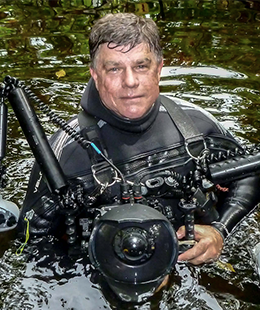 Founder/Director of the Bahamas Caves Research Foundation
Co-Owner/Operator of Bahamas Underground Cave and Technical Diving Facility
Brian is a former U.S. Navy Diver with over 30 years of professional diving experience. His work has taken him beneath nuclear submarines and aircraft carriers, to jumping from helicopters into 10- foot seas to recover million-dollar weapon systems, to record penetrations of underwater cave systems around the world. His research diving work with various governmental and scientific institutions has revealed new species of cave adapted marine life, as well as the discovery of fossils that are now repainting the picture of the Bahamas past environment.
His expertise in diving safety has been used widely in the feature film industry as a Diving Safety Officer and underwater stuntman. With more than 3000 exploration cave dives, Brian is considered one of the leading authorities on the underwater/underground environments of the Bahamas and is a veteran of multiple high-profile underwater cave expeditions in the Bahamas, Mexico, Belize, Bermuda, Dominican Republic, Australia, Christmas Island, Sardinia Italy, Kefalonia, Greece, Budapest, Hungary and the U.S.
Though a seasoned underwater explorer, photographer, author, cave diving instructor and conservationist, Brian’s primary efforts are in the pursuit of the protection of underwater caves in the Bahamas, with a current focus on the Crystal Caves of Abaco Island and the massive fracture caves of Andros Island. Brian is working hand in hand with the Bahamian Government and local NGOs to preserve the world’s most highly decorated and scientifically significant underwater cave systems.
On the side, Brian assists several equipment manufacturers with the development of new side mounted cave diving equipment and closed-circuit breathing apparatus.
Brian is an Advanced Cave and Technical Instructor Trainer for and serves on the International Advisory Board of the International Association of Nitrox and Technical Divers (IANTD). He is a Cave Diving Instructor for the U.S. National Speleological Society – Cave Diving Section and Diving Consultant for the National Museum of the Bahamas (Antiquities Monuments and Museums Corporation) and is a Fellow of the Explorer’s Club of New York.
Andreas Klocker
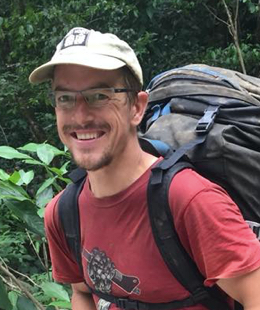 Andreas Klocker started his caving career in the Junee-Florentine in Tasmania which is seen by many as Australian’s most challenging caving area, with some of the largest vertical pitches and challenging sumps in the country. While he has been diving since the mid 90s, it was only while exploring caves in the Junee-Florentine, with the main goal to find the main drain of this cave system, that he needed to become a cave diver to explore further. Luckily, he then spent two years in the US for work, giving him a chance to learn in the pleasant springs in Florida.
He has since been caving and cave diving on several big expeditions in Mexico and New Zealand, where he particularly enjoyed the challenge of combining dry caving and cave diving to be able to push beyond the point where pure dry cavers or cave divers had to halt exploration. In 2015, Andreas and his caving buddy Zeb Lilly led a successful push in Sistema Huautla, the deepest cave in the Western Hemisphere, to explore beyond several sumps in Redball Canyon. This trip involved several sustained camping trips underground, daily commutes through several sumps, and multiple aid climbs to work from a depth of 750 metres towards the surface.
It was on this expedition that those two decided to restart efforts to connect Sump 9 in Sistema Huautla to its resurgence in the 10 kilometres distant Santo Domingo canyon. If successful, this connection would make Sistema Huautla the deepest and one of the most spectacular cave through-trips in the world. This was the beginning of Beyond the Sump Expeditions, a project bringing together an international team of cave explorers, with both advanced caving and cave diving skills, to explore some of the most remote places found inside the Earth.
In 2019, this team started exploring the Río Uluapan resurgence in the Mexican state of Oaxaca, not far from Sistema Huautla. With more flow coming out of the resurgence than all other caves in the area, passage dimensions of over 20 x 40 metres, and the source of the water being completely unknown, this is probably one of the most amazing cave diving leads on the planet. During this expedition the team pushed the cave to about two kilometres in length, with the second sump just having cracked 100 metres depth about one kilometres into the second sump.
While Andreas started his rebreather diving on a KISS Classic, over the last couple years he has been exploring on the KISS Spirit Sidewinder. Planning for the upcoming expedition to continue exploration in the Río Uluapan, which will require very long and deep dives, he is now working on combining his KISS Classic and Sidewinder to a dual unit capable of continuing exploration in this challenging environment.
For news on exploration by the Beyond the Sump team, follow www.facebook.com/cavedive or have a look at www.beyondthesump.org.
If Andreas is not in a cave he can be found exploring deep reefs off the coast of Tasmania.
Cristina Zenato
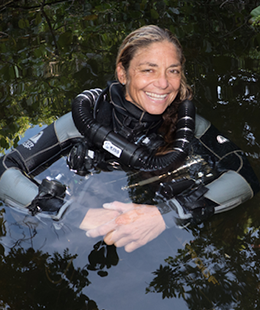 A professional diver since 1994, Cristina is an ocean and cave explorer, a shark expert, a speaker, writer and conservationist. Among her qualifications, Cristina is a PADI Course Director, NSS-CDS Advanced Cave Diving Instructor and a TDI mixed gas instructor and she specializes in the Shark Handling courses and interactive dives.
Cristina is known for her special relationship with her local sharks and her passion for promoting the protection of all sharks in the world.
She is an active cave instructor and avid explorer. To date she holds the record for connecting a land cave with an open ocean blue hole and has completed two surveys of two full cave systems. She is currently working on a third project. Through exploration work she found some interesting facts about the islands’ cave systems and the impending need to protect them.
Her field work with sharks and caves allows her to bring to the surface a unique prospective on life with a conservation approach to our relationship with this Planet and other people.
Cristina shares her time between teaching at different scuba levels, primarily professional and technical, working with sharks and exploring and mapping different underwater cave systems.
Her biggest passion is teaching and sharing with the new and younger generations, offering support, training and mentorship.
Cristina has been inducted in the Women Divers Hall of Fame, the Explorers Club, the Ocean Artists Society and she is a Platinum Pro 5000 recipient. Cristina is the founder of the nonprofit People of the Water www.POWnonprofit.org organized to widen the conduction and distribution of training, education, research, and studies relating to water, ocean and environmental issues, affecting both the people and the animals of said environments.